
22. Juni 2026, 14:15 – 14:45 Uhr
Decolonizing AI: Intersectional, Feminist & Ecological Literacy for Academics
As AI reshapes research across disciplines, its deployment often reproduces systemic inequalities, epistemic violence, and ecological harm — placing universities under pressure to respond. I present a tested prototype for critical AI literacy, developed at Freie Universität Berlin, designed as a 2-hour crash workshop for academics.
This is not a technical tutorial — it’s a pedagogical intervention that positions AI not as a neutral tool, but as a site of political, epistemic, and ecological contestation. The workshop integrates:
Bias auditing pipelines — to surface and interrogate algorithmic discrimination
CO₂ estimation for AI workflows — to make ecological costs visible and actionable
Mitigation of AI hallucinations & fake epistemologies — through interpretive, context-aware evaluation
Use of academic, non-hegemonic, European, feminist, and open-source models — deliberately moving beyond ChatGPT, Claude, and other US-corporate AI that reproduce global inequalities
Human-centered evaluation — treating AI outputs as interpretive data points, not authoritative answers
The prototype is designed to be co-developed, adapted, and scaled — and I am seeking host universities across Europe to invite me to run this lab with their students, faculty, or research groups. All collaborators will be acknowledged in resulting publications and presentations.
This session is an invitation to join a growing network of institutions committed to responsible, critical, feminist, and intersectional AI education — not as an add-on, but as a core competency for 21st-century academia.
👥 Target Audience
Faculty, BA/MA students, Professors, Research Groups, Feminist Scholars, BIBOC Communities, AI Ethics Officers, University Administrators — especially those interested in piloting critical AI literacy at their institution.
Sie sehen gerade einen Platzhalterinhalt von Standard. Um auf den eigentlichen Inhalt zuzugreifen, klicken Sie auf den Button unten. Bitte beachten Sie, dass dabei Daten an Drittanbieter weitergegeben werden.
Weitere InformationenLiteratur: Breyer-Mayländer, T., Drechsler, D., & Zerres, C. (Hrsg.). (2025). KI-Transformation in Deutschland : Veränderungen in Gesellschaft, Kultur, Bildung und Wirtschaft / Thomas Breyer-Mayländer, Dirk Drechsler, Christopher Zerres. (1st ed.). utb GmbH. https://doi.org/10.36198/9783838565385 Criado-Perez, C. (2020). Invisible women : exposing data bias in a world designed for men / Caroline Criado Perez. Vintage. https://bvbr.bib-bvb.de:443/F Hao, K. (2025). Empire of AI : dreams and nightmares in Sam Altman’s OpenAI / Karen Hao. Penguin Press. https://bvbr.bib-bvb.de:443/F Haraway, D. J. (1991). A Cyborg Manifesto: Science, Technology, and Socialist-Feminism in the Late Twentieth Century 1. In Simians, Cyborgs, and Women (1st ed., pp. 149–181). Routledge. https://doi.org/10.4324/9780203873106-12 _________ (2016). Staying with the trouble : making kin in the Chthulucene / Donna J. Haraway. Duke University Press. https://doi.org/10.1515/9780822373780 Kirste-Gossin, A. (2025). Künstliche Intelligenz und digitale Tools als Co-Piloten der Bildung: Neue Impulse für Lehr- und Lernkulturen. In: Hanstein, P.D.T., Lanig, P.D.A. (eds) Bildungsmanagement in Dezentralität und Wandel. Berufspädagogik & Bildungsmanagement, vol 1. Springer VS, Wiesbaden. https://doi.org/10.1007/978-3-658-49406-3_11 Klipphahn-Karge, M., Koster, A.-K., Santos Bruss, S. M. dos, & SLUB Dresden funder. (2022). Queere KI : Zum Coming-out smarter Maschinen. (1st ed.). transcript. https://doi.org/10.1515/9783839461891 Lee, R.S.T. (2020). AI Ethics, Security and Privacy. In: Artificial Intelligence in Daily Life. Springer, Singapore. https://doi.org/10.1007/978-981-15-7695-9_14 Lundberg, R. (2025). Technocolonialism: When Technology for Good is Harmful: by Mirca Madianou, Cambridge, UK, Polity Press, 2025, 256 pp., ISBN 9781509559039 (paperback), ISBN 9781509559022 (hardcover), ISBN 9781509559046 (e-book). Anthropological Forum, 35(3), 300–302. https://doi.org/10.1080/00664677.2025.2553126 McInerney, K., Browne, J., Cave, S., & Drage, E. (2024). Digital Ageism, Algorithmic Bias, and Feminist Critical Theory. In Feminist AI. Oxford University Press, Incorporated. https://doi.org/10.1093/oso/9780192889898.003.0018 Mensah, M., & van Wynsberghe, A. (2025). Sustainable AI meets feminist African ethics. Ai and Ethics (Online), 5(4), 4293–4303. https://doi.org/10.1007/s43681-025-00705-9 Quadflieg, S., Sametinger, F., Augsten, A. (2025). Mit, über und durch KI gestalten – Perspektiven auf eine zukunftsorientierte Designlehre. In: Grabbe, L.C. (eds) Designforschung und KI. Designforschung – Designwissenschaft - Designtheorie. Springer VS, Wiesbaden. https://doi.org/10.1007/978-3-658-49798-9_7 Rainie SC, Kukutai T, Walter M, et al. (2019) Indigenous data sovereignty. In: Davies T, Walker S, Rubinstein M and Perini F (eds) State of Open Data: Histories and Horizons. African Minds, pp.300–319. Varon, J., & Peña, P. (2021). Artificial intelligence and consent: A feminist anti-colonial critique. Internet Policy Review, 10(4), 1–25. https://doi.org/10.14763/2021.4.1602 Yawson, R. M. (2025). Perspectives on the promise and perils of generative AI in academia. Human Resource Development International, 28(3), 476–487. https://doi.org/10.1080/13678868.2024.2334983
Zusammenfassung: dlc.sh/sessionaizer/sessions/360
Speaker:innen
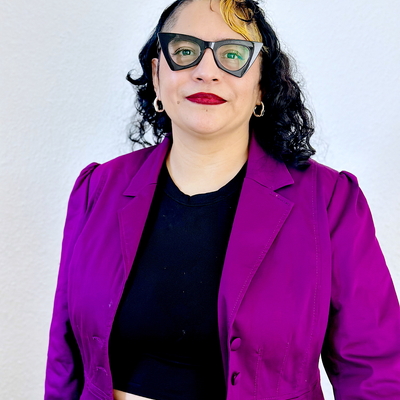 Verónica Mota Galindo
Academic Researcher, Philosophy of Technology, Gender and Decolonial Studies
Track
Innovative Learning
Raum
Global Perspectives (DIGITAL)
Sprache
EN
Format
Input


