
23. Juni 2026, 10:00 – 13:15 Uhr
Lernen zwischen Präsenz und Virtualität: Didaktik in Cross Reality
Wie kann Cross Reality (XR) partizipativ und niedrigschwellig in die Hochschullehre integriert werden? Im Forschungsprojekt XRwise wird eine hybride No-Code Plattform entwickelt, die Begegnungen in einer gemeinsamen virtuellen Umgebung ermöglicht und damit Lernen über physische und digitale Räume hinweg. Mit dieser Plattform wird das didaktische Potenzial von XR-Formaten aufgezeigt und praktische, didaktische und organisatorische Hürden realer Lehrkontexte diskutiert.
Am 23. Juni präsentieren wir Lightning Talks aus einem gemeinsamen virtuellen Raum, live übertragen in die Festivalräume in Braunschweig und Berlin. Lehrende verschiedener Hochschulen teilen in je fünf Minuten ihre Erfahrungen. An allen weiteren Festivaltagen sind bestehende Lehr- und Vermittlungsräume sowohl online als auch am Festivalort Berlin zugänglich und erkundbar. Teilnehmende können vor Ort dabei sein oder sich remote zuschalten.
Das Programm: xrwise.tech/uff
Remote-Teilnahme: xrwise.tech/join
Literatur: Milgram, P., & Kishino, F. (1994). A taxonomy of mixed reality visual displays. IEICE Transactions on Information and Systems, E77-D(12), 1321–1329. Billinghurst M, Clark A, Lee G (2015), "A Survey of Augmented Reality". Foundations and Trends in Human-Computer Interaction, Vol. 8 No. 2-3 pp. 73–272, doi: https://doi.org/10.1561/1100000049 Speicher, M., Hall, B. D., & Nebeling, M. (2019). What is mixed reality? In Proceedings of the 2019 CHI Conference on Human Factors in Computing Systems (CHI ’19) (Paper 537, pp. 1–15). Association for Computing Machinery. https://doi.org/10.1145/3290605.3300767 Conrad, M., Kablitz, D., & Schumann, S. (2024). Learning effectiveness of immersive virtual reality in education and training: A systematic review of findings. Computers & Education: X Reality, 4, Article 100053. https://doi.org/10.1016/j.cexr.2024.100053 Makransky, G., & Lilleholt, L. (2018). A structural equation modeling investigation of the emotional value of immersive virtual reality in education. Educational Technology Research and Development, 66(5), 1141–1164. https://doi.org/10.1007/s11423-018-9581-2
Beitragende: Tom Milter, Luzie Ahrens, Francesco Vona
Speaker:innen
 Anke von der Heide
Hochschule Hamm-Lippstadt Projectlead and Research XRwise Ceenu George
TU Berlin, Professor for Human-Computer Interaction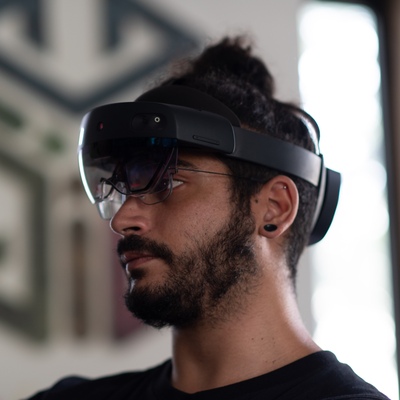 Francesco Vona
Hochschule Hamm-Lippstadt, senior researcher, PhD
Track
Innovative Learning
Raum
Future Tech:Stage Braunschweig – Workshops
Sprache
EN
Format
Other format
Sondercluster
Fringe


